The standard approach to GDPR data discovery is a project: engage a consultancy or internal privacy team, spend three to six months mapping data flows across the organisation, document the results in a Record of Processing Activities, and treat the exercise as complete. The ROPA gets filed, the consultants depart, and the compliance programme continues with a data map that is already beginning to age. Within six months, that map is frequently a liability — not an asset.
This article sets out why the project model is structurally inadequate for organisations operating under GDPR, and what a continuous discovery approach requires in practice.
The decay rate of point-in-time data mapping
Data infrastructure at mid-market and enterprise organisations changes faster than annual or biannual audit cycles can track. Engineering teams add new data sources, create new tables, modify schemas, and deploy new pipelines continuously. SaaS tools get added to the stack without formal GDPR assessment. A marketing team connects a new email automation platform; an HR department enables a new payroll integration; a product team launches an experiment table containing device fingerprints — all without informing the privacy officer.
Data engineering change rates vary by organisation maturity, but a reasonable working estimate is that 30–40% of tables in an active data warehouse will experience a schema change within six months of a point-in-time classification. New columns are added; columns are renamed or repurposed; entire schemas are deprecated. Each of these changes is a potential blind spot in the compliance map — a location where personal data may exist without documentation or policy coverage.
The downstream consequence is visible during DSAR and breach events: the privacy officer queries the ROPA, finds a data subject's records in the documented systems, and later discovers additional records in a pipeline that was added after the last mapping exercise. The DSAR response is incomplete. The breach scope is underestimated. Supervisory authority investigations then expose the gap — not just the incident, but the process that allowed the gap to form.
What continuous data discovery changes
A continuous discovery system operates on a fundamentally different model: instead of scanning the data estate once and documenting the result, it scans continuously on a configurable cadence — hourly for high-change warehouses, daily or weekly for stable systems — and updates the compliance map in near-real time. The output is not a static document but a live graph reflecting the current state of every connected data source.
The practical difference is most visible in three operational scenarios. First, when a DSAR arrives, the subject lookup runs against current data, not a months-old inventory. Second, when a data incident occurs, breach scoping queries the live classification graph to enumerate affected fields and estimate impacted data subject counts without emergency manual classification. Third, during a supervisory authority investigation, the organisation presents a demonstrably current data map rather than a document dated to a prior audit cycle.
A Tier-1 European bank's data platform team observed that their prior point-in-time ROPA covered 73% of active Snowflake schemas. Within eight months of the last audit, three new dbt pipelines had been added containing customer transaction metadata — none reflected in compliance documentation. Continuous scanning surfaced all three within hours of first ingestion.
The classification accuracy requirement
Continuous discovery creates a classification accuracy challenge that periodic discovery does not face as acutely. In a periodic review, an experienced privacy consultant can manually verify ambiguous classifications across a bounded set of tables. In a continuous system scanning thousands of tables across multiple sources on an ongoing basis, manual verification of every classification is not operationally feasible.
This is where NLP-based classification becomes operationally necessary. A classifier that combines column name analysis, table context, data type, and statistical sampling of column values can achieve accuracy high enough to auto-approve the majority of cases — typically those where multiple signals agree strongly — while routing genuinely ambiguous cases to a human reviewer queue. The volume of cases requiring human judgment shrinks to those where it actually adds value.
The classifier also needs to handle the GDPR distinction between directly identifying data (name, email, ID number under Article 4(1)) and indirectly identifying data (IP address, device fingerprint, behavioural identifier). EU enterprise systems use naming conventions that differ from US schemas — a classifier trained only on English-language US data will miss common patterns in DACH and Benelux environments.
Coverage metrics and compliance confidence
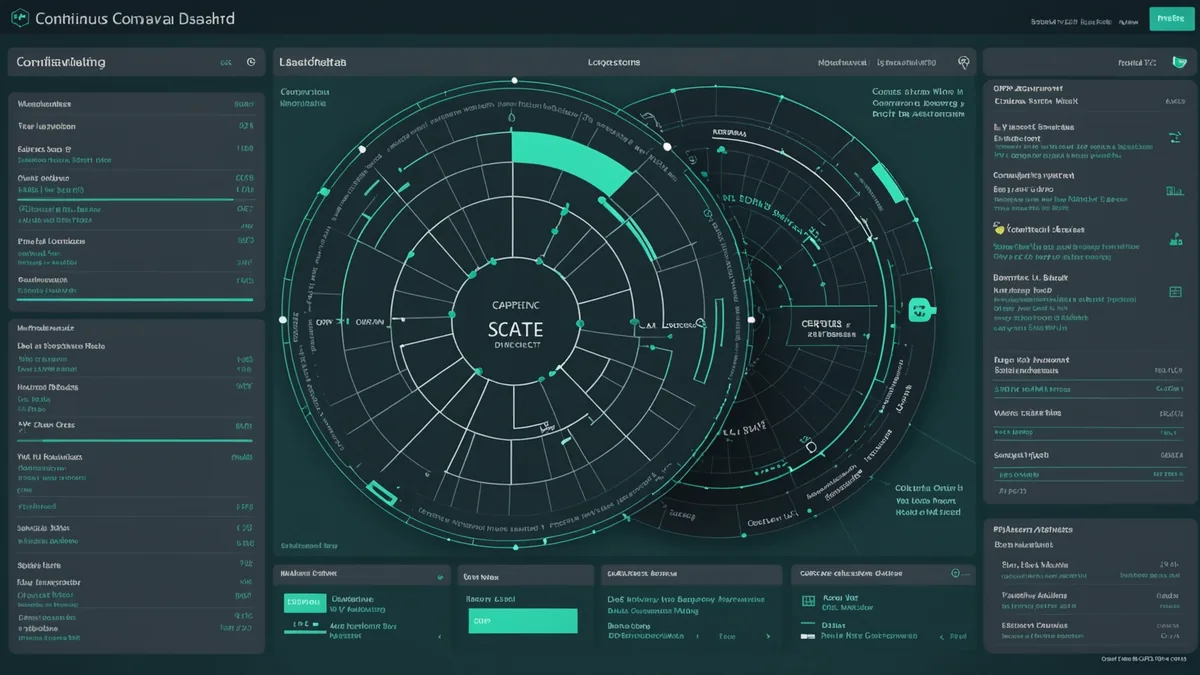
One operational benefit of continuous discovery is the ability to measure classification coverage explicitly. A coverage dashboard might show that 94% of warehouse tables have been classified with confidence scores above the auto-approve threshold, 4% are queued for human review, and 2% are newly created and awaiting the next scan cycle. This is a fundamentally different assurance model than a point-in-time audit: instead of asserting that the estate was fully mapped as of a particular date, the organisation can demonstrate ongoing coverage with a live metric.
Coverage gaps become visible rather than invisible. When a new Salesforce object is added containing a custom field for a medical condition indicator — a special-category GDPR field under Article 9 — the discovery system flags it within hours. The privacy officer reviews the classification, confirms the Article 9 basis, and the field is added to the compliance map with appropriate policy rules. The alternative — discovering the field during the next annual audit, eighteen months later — creates eighteen months of undocumented special-category processing.
The accountability principle in operational terms
GDPR Article 5(2) requires that controllers be able to demonstrate compliance with the regulation's data protection principles — not just assert it. The accountability principle has material implications for how compliance infrastructure is designed. A ROPA that cannot be regenerated to reflect current reality does not satisfy accountability requirements in any meaningful operational sense; it satisfies them at the moment of production and immediately begins to diverge from the live estate.
Continuous discovery is the operational translation of accountability. It means maintaining the compliance infrastructure — the classification graph, the policy mapping, the lineage model — as a running system that reflects current reality rather than a historical snapshot. The compliance officer is not just a document producer; they are an operator of a live compliance system whose output quality depends on the currency of the underlying data.
Practical implementation considerations
Organisations moving from periodic to continuous discovery face a sequencing challenge: the initial scan must classify the existing estate before incremental scanning can detect changes. For a warehouse with 500+ tables, the initial classification run is a significant workload — typically 2–4 weeks when combining automated scanning with human review of mid-confidence cases. The ongoing incremental load, once the baseline is established, is substantially lower.
Scan cadence should match the rate of change at each source. A Snowflake data warehouse used by an active engineering team may warrant daily scans; a Redshift cluster used only for quarterly reporting might run weekly. Configurable per-source cadence prevents unnecessary load while ensuring that high-activity sources stay current.
Conclusion
The periodic audit model is not a conservative approach to GDPR compliance — it is a deferred risk model that concentrates exposure at exactly the moments when continuous coverage matters most: the DSAR deadline, the 72-hour breach notification window, the supervisory authority request. Continuous data discovery does not eliminate compliance work; it redistributes it from reactive crisis management to ongoing operational discipline, where it is both more effective and less costly.
Source notes
- European Data Protection Board, Guidelines on the concepts of controller and processor in the GDPR (07/2020, adopted 2021) — accountability and documentation obligations
- Article 29 Working Party, Guidelines on Data Portability (WP242, 2016) — DSAR scope and completeness requirements
- Information Commissioner's Office, Accountability framework: Records of processing activities (2021 edition) — ROPA currency expectations
- ENISA, Recommendations on shaping technology according to GDPR provisions (2018) — technical implementation guidance for continuous compliance monitoring
- Datatilsynet (Norwegian DPA), Artificial intelligence and privacy (2018) — classification methodology and indirect identifier treatment under Article 4(1)