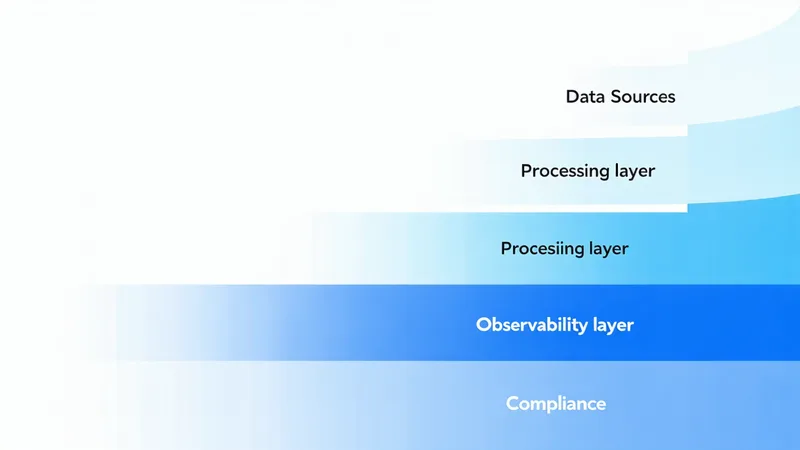
The term "data observability" covers a broad category of tooling: pipeline monitoring, data freshness checks, schema validation, anomaly detection on data distributions, column-level lineage tracking, and end-to-end data quality alerting. The category has grown substantially since 2020, and the vendor landscape now ranges from open-source components that data engineers assemble themselves to commercial platforms that promise comprehensive coverage out of the box.
Most of this tooling was designed with operational use cases in mind: preventing pipeline SLA violations, catching bad data before it reaches a dashboard, reducing mean time to detection when a data quality issue surfaces. Compliance was not the primary design consideration for any of the established platforms in this space.
That does not mean observability tooling is compliance-neutral. It means the compliance implications of the architectural decisions involved in deploying it are often not evaluated during the procurement and implementation process. This article covers the decisions that matter.
The Core Architectural Question: Where Does the Monitor Sit?
The first compliance-relevant decision is where in the data architecture the observability layer operates. There are broadly three positions.
At-rest monitoring on the data warehouse
The observability tooling queries the data warehouse or data lake directly, running freshness checks, row count validations, schema comparisons, and distribution anomaly tests against the actual data. This approach gives the highest signal fidelity — it is testing against production data — but it also means the observability platform has direct access to production personal data. That access needs to be treated as a processing activity: the observability platform becomes a processor under the GDPR, a DPA must be in place, and any data residency requirements must be met by the platform's data access and (if it samples data for anomaly models) data retention behaviour.
Metadata-only monitoring
Some approaches operate on metadata — schemas, row counts, column statistics — without ever accessing the contents of personal data fields. A schema comparison that detects column type changes operates on the DDL, not the data. A freshness check that measures last-modified timestamps on table partitions does not read personal data values. For many compliance-relevant monitoring use cases, metadata-only monitoring achieves the goal without creating a secondary personal data access problem.
The limitation is that metadata monitoring cannot detect distribution anomalies or data quality issues that require looking at actual values — a field that starts accepting structurally valid but semantically incorrect data (a postcode field populated with phone numbers, for instance) will pass metadata-only tests.
Transformation-layer monitoring
Some observability implementations monitor at the transformation layer — instrumenting the ETL or ELT processes to capture row-level statistics, error rates, and schema changes as transformations execute. This is often the most natural integration point for dbt-based pipelines, where test results and model execution metrics are already captured. The compliance question is whether the monitoring captures any row-level data samples as part of its anomaly detection — if so, the same processor relationship considerations apply as with at-rest monitoring.
Data Sampling and the Personal Data Boundary
Several commercial observability platforms use statistical sampling to build baseline models for anomaly detection: they ingest samples of your data to learn what "normal" looks like and then alert when distributions shift. This is technically effective. It is also a processing activity.
If the sampled data includes personal data fields, the platform is processing personal data on your behalf. The implications: a DPA must be in place, the sampling behaviour and retention of samples must be documented in the ROPA, and any cross-border transfer of samples (if the platform operates outside the EEA or Switzerland) requires an appropriate transfer mechanism.
We are not saying that sampling-based observability is impermissible — it is not. We are saying that this processing activity is frequently overlooked during platform procurement because the sampling happens under the hood and is not prominently disclosed in sales conversations. Asking the platform vendor specifically: "Do you sample our data for model training or anomaly baseline construction, and if so, how and where is that data retained?" is a due diligence question that belongs in your processor assessment.
Schema Change Alerting and Compliance Notification Routing
Schema change detection — alerts when a column is added, removed, or type-changed — is one of the most compliance-valuable observability capabilities, for the reasons explored in our earlier piece on schema drift. The configuration question is where those alerts are routed.
Most observability platforms route alerts to Slack channels, PagerDuty, or email groups set up by the data engineering team. These routing configurations were designed for operational alerting. For compliance purposes, alerts on tables classified as containing personal data need to reach the DPO or compliance function — not just the data engineering on-call rotation.
Achieving this requires a classification layer: a way to tag specific tables or datasets as containing personal data, so that the alert routing logic can differentiate between "the orders table changed schema" (route to data engineering) and "the user_profiles table containing email addresses and behavioural segments changed schema" (route to data engineering and DPO).
Some commercial platforms offer this natively through data classification tags. Others require it to be implemented at the infrastructure level — a table metadata tag that the alerting logic reads. In either case, this configuration step is typically not included in a standard platform onboarding and needs to be specified as a requirement during implementation.
Lineage Coverage and the ROPA Connection
Observability platforms that include lineage tracking — showing how data flows from source systems through transformations to consumption layers — provide a natural foundation for ROPA maintenance. The question is whether the lineage coverage is complete enough to be relied upon for compliance documentation.
Lineage coverage is typically strongest for the pipelines directly instrumented by the observability platform: the dbt models it runs tests on, the warehouse tables it monitors, the transformation jobs it integrates with. It is typically weakest for: direct database queries from BI tools, ad-hoc analytical scripts, data exports to external systems through non-pipeline channels, and any data processing that happens outside the monitored environment.
For compliance teams considering whether to rely on observability-generated lineage for ROPA documentation, the honest question is: does the platform's lineage coverage match the scope of your personal data processing, or does it cover only a portion of it? A lineage graph that covers 80% of your data flows is better than none — but if the 20% gap includes the email marketing integration that sends personal data to an external processor, the gap is material.
Data Residency and Processor Location
For Swiss-based organisations or EU companies processing under the FADP, the physical location of the observability platform's infrastructure matters. If the platform is US-hosted and accesses personal data for at-rest monitoring or sampling, you have a third-country transfer to the United States that requires SCCs or another transfer mechanism.
Many commercial observability platforms offer EU-region deployment options. This is worth specifying as a requirement before signing a contract, rather than discovering after deployment that the platform's metadata and anomaly models are processed in a US region by default.
Choosing an Architecture
For a growing company deploying data observability for the first time, the compliance-friendly approach is to begin with metadata-only monitoring on classified personal data systems, with schema change alerts routed to both engineering and compliance. That configuration produces compliance-relevant signals immediately, with no secondary processing of personal data.
For organisations that need distribution-level anomaly detection — and the operational benefits of sampling-based baselines — the additional processor due diligence (DPA, data residency check, ROPA entry for the observability platform as processor) is manageable overhead. The observability platform becomes a processor in the same category as your analytics warehouse provider or your CRM vendor: a documented, contracted relationship with clear data handling obligations.
The organisations that encounter problems are those that deploy observability platforms without considering the processor relationship implications at all, and then face a DPA audit request that asks them to account for all processors that access personal data — and discover their monitoring stack is not on the list.