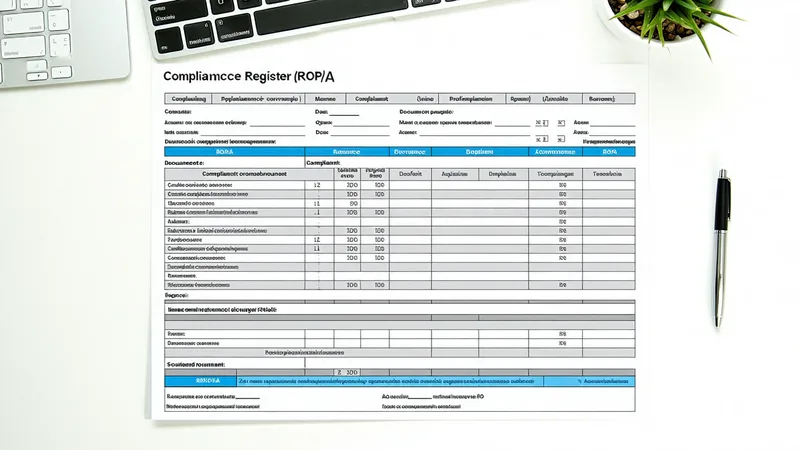
Art. 30 GDPR requires controllers to maintain a record of processing activities. It specifies what the record must contain: the purposes of processing, categories of data subjects and personal data, categories of recipients, transfers to third countries, retention periods, and a description of technical and organisational security measures. It does not specify how the record should be maintained, updated, or connected to the actual data flows it purports to describe.
That procedural silence is why the majority of ROPAs in practice are spreadsheets that no one updates. The initial creation of the ROPA is treated as a project with a clear deliverable — a document — rather than as an ongoing operational discipline. Once the spreadsheet is filed, the maintenance question gets deferred indefinitely.
The Structural Problems With Most ROPAs
There are three failure modes we see consistently. Understanding them is more useful than prescribing a template, because the right structure depends on the organisation's size and data complexity — but the failure modes are nearly universal.
Processing activities are too coarsely described
A ROPA entry that says "Customer relationship management — marketing and sales" covers an enormous range of actual processing. It tells a supervisory authority almost nothing about what data is held, where it comes from, who can access it, and where it goes. More importantly, it makes the ROPA useless for its own internal purposes: you cannot use it to scope a DSR response, to assess whether a new integration requires a new legal basis, or to check whether a retention policy is being enforced.
A well-structured ROPA entry should be specific enough that an engineer who has never read GDPR documentation could, from the entry alone, identify the relevant system, the relevant data fields, and the relevant downstream recipients. If that test fails, the entry is too coarse.
The ROPA is owned by legal, not by the people who know the data
Legal and compliance teams draft ROPAs. Data engineering and product teams change the systems. These two groups typically do not have a standing interface around data processing changes, which means the ROPA documents a state that no longer exists.
The ownership model needs to include a technical co-owner — typically a data engineer or data platform lead — who is accountable for notifying the DPO when changes in their domain affect the ROPA. Without that co-ownership, the ROPA will decay within months of its creation.
There is no maintenance trigger
Annual reviews are not sufficient for organisations with active data pipelines. A new SaaS integration can create a new processing activity, a new processor relationship, and a new international transfer within a single sprint. If the only ROPA review mechanism is an annual scheduled review, a year's worth of changes accumulates between reviews.
The most effective maintenance trigger is event-based rather than calendar-based: any engineering change that touches a system holding personal data should prompt a ROPA check. That check does not need to be burdensome — a short checklist with four questions (does this change new processing? does it affect the categories of data involved? does it affect recipients? does it affect retention?) takes less than ten minutes and catches almost all relevant changes.
A Workable Structure for a ROPA Entry
Rather than specifying column headers — which will vary by organisation — it is more useful to specify the information that every ROPA entry should be able to answer. Think of each entry as a processing activity dossier that should address the following:
- Name and system reference: What is this processing called, and which system(s) is it implemented in? A system reference (e.g., a data catalog identifier, a system name from your architecture diagram) grounds the entry in something auditable.
- Controller / processor distinction: Is the organisation acting as a controller for this activity, as a processor on behalf of another controller, or both? This determines what obligations apply.
- Purpose and legal basis: What is the processing for, and what is the Art. 6 (and where relevant, Art. 9) basis? The legal basis should be specific — "legitimate interests" requires a documented balancing test; "consent" requires a reference to the consent record or mechanism.
- Data subjects and data categories: Who is this data about, and what types of data are involved? If special category data (Art. 9) is involved, flag it explicitly and note the Art. 9(2) basis.
- Processors and sub-processors: If personal data is transferred to a processor — a cloud infrastructure provider, a CRM vendor, an analytics tool — the DPA must be in place and referenced here.
- Retention: How long is data held in this activity, and what triggers deletion or archiving? A retention period that says "as long as the customer relationship is active" is not sufficient — it needs to specify what happens to the data after the relationship ends.
- International transfers: If data moves outside the EEA (or Switzerland), the transfer mechanism must be documented here.
- Last reviewed: A timestamp and reviewer. This is the field that enforces accountability.
The ROPA as an Internal Compliance Tool
A ROPA that is only ever looked at during a supervisory authority inquiry is a liability management document. A ROPA that is actively used for DPIA scoping, DSR response, onboarding of new processors, and training of new team members is a compliance asset.
The difference is frequency of use. If your DPO and your data team are referencing the ROPA several times a month — to check whether a new integration needs a new ROPA entry, to scope an access request, to review what data a specific processor holds — then the motivation to keep it current exists naturally. If it is reviewed once a year, there is no natural pressure to maintain accuracy.
We are not saying that a well-maintained ROPA is sufficient for compliance. It is not — the ROPA documents what is happening; separate controls are needed to ensure what is happening is lawful. But a ROPA that no longer reflects your actual processing activities is worse than useless in an investigation, because it documents unlawfulness you were not even aware of.
Making It Maintainable at Scale
For organisations with more than 50 staff, the ROPA often needs to be segmented by business unit or system owner to be manageable. A central DPO maintaining a single monolithic spreadsheet for 200 employees across five product lines will lose the update battle. A federated model — where each product or engineering team maintains the entries for their systems, the DPO provides the template and governance, and a senior review happens quarterly — distributes the maintenance burden to the people closest to the data.
The governance question is where that model breaks down: if the federated owners are not accountable for the accuracy of their entries, the ROPA fragments into poorly-maintained silos. Quarterly DPO-led reviews that cross-check ROPA entries against actual system configurations — even if superficially — maintain the accountability signal. The ROPA does not need to be perfect at every moment; it needs to be accurate enough that anyone relying on it for a compliance decision can trust it.